
Album Review: GORILLAZ - 'The Mountain'
On their ninth album, the world’s first virtual band is still keeping it real, with some next-level INDIAMAXXING and a guest list that would make David Bowie smile from the mountaintop.

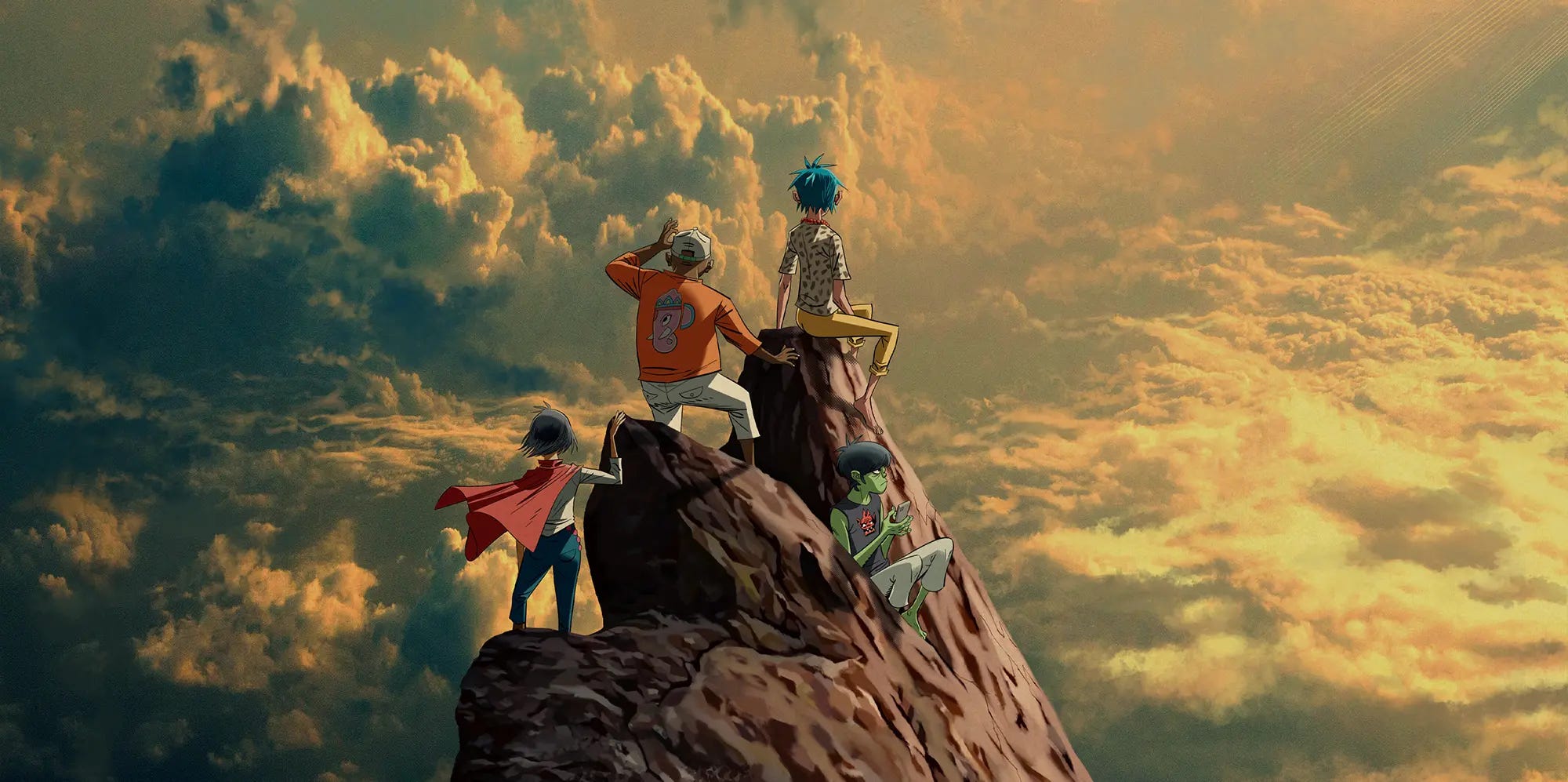
Most death albums usually aren’t much fun. The Mountain, Gorillaz’s ninth album, is an exception. It evinces the “Everybody Wants to Rule the World” principle: If a song is catchy and pretty enough, you can say anything you want. The perfect example on The Mountain is “The Hardest Thing” and “Orange County,” which are separate tracks, even though they’re perfect together and were released as a single. Their mantra is “You know the hardest thing / is to say goodbye / to someone you love / that is the hardest thing.”
We hear the voice of legendary drummer Tony Allen, the now-deceased polyrhythmic architect of Fela Kuti’s Afrobeat—a genre of music that could bring corpses to life in dance—saying “Oya E dide erori,” which translates to “We are ready, let’s go.” The fact that the percussionless song features Allen feels almost like a troll. Instead, we get the somber parts of Bowie’s s Low (1977), one of the greatest albums ever made.
Then the fog clears and “Orange County” starts as the mantra continues: “You know the hardest thing / is to say goodbye to someone you love….” The song is infectious — the mariachi horn-hop over a Balkan beat and dreamy acoustic guitar strum somehow keep the whistled melody from getting old. Kara Jackson, 2019 U.S. National Youth Poet Laureate, sings the lovely “I’m not your enemy” bridge.
Anytime I listened to “Hardest Thing/Orange County” while my kids were around, they got so happy: “Is that the one with the whistles? I LOVE it!” But for me, watching them enjoy the song was a bittersweet experience. The song’s mantra, “You know the hardest thing / is to say goodbye to someone you love” is a reality of parenthood, which is so ruthless and beautiful.
The Mountain is full of apparitions, the ghost voices of Gorillaz collaborators who have died: Bobby Womack, David Jolicoeur from De La Soul, actor Dennis Hopper, Mark E. Smith from the Fall, and Proof from D12.
Death is central to the album in every sense.
Gorillaz creators Damon Albarn and Jamie Hewlett both lost their fathers in 2024, ten days apart. Then they went to India together, to begin work on what would become The Mountain and “The Mountain, The Moon Cave and The Sad God,” a nine-minute short film that captures the essence of the entire concept.
England, Albarn told The Sun, is just really bad at dealing with death. He visited Varanasi, the primary cremation site for the Hindu death ritual, which they believe achieves moksha (liberation from the cycle of birth and death). “On the banks of the Ganges,” he said, “every family is there with the body wrapped in a shroud and they’re burnt, and it’s going on everywhere. It goes on 24 hours a day and it’s been going on for thousands of years.”
He swam through the frothy, brown-green water, then cast his father’s ashes into the current, overcome by the phrase, “This is beautiful.”
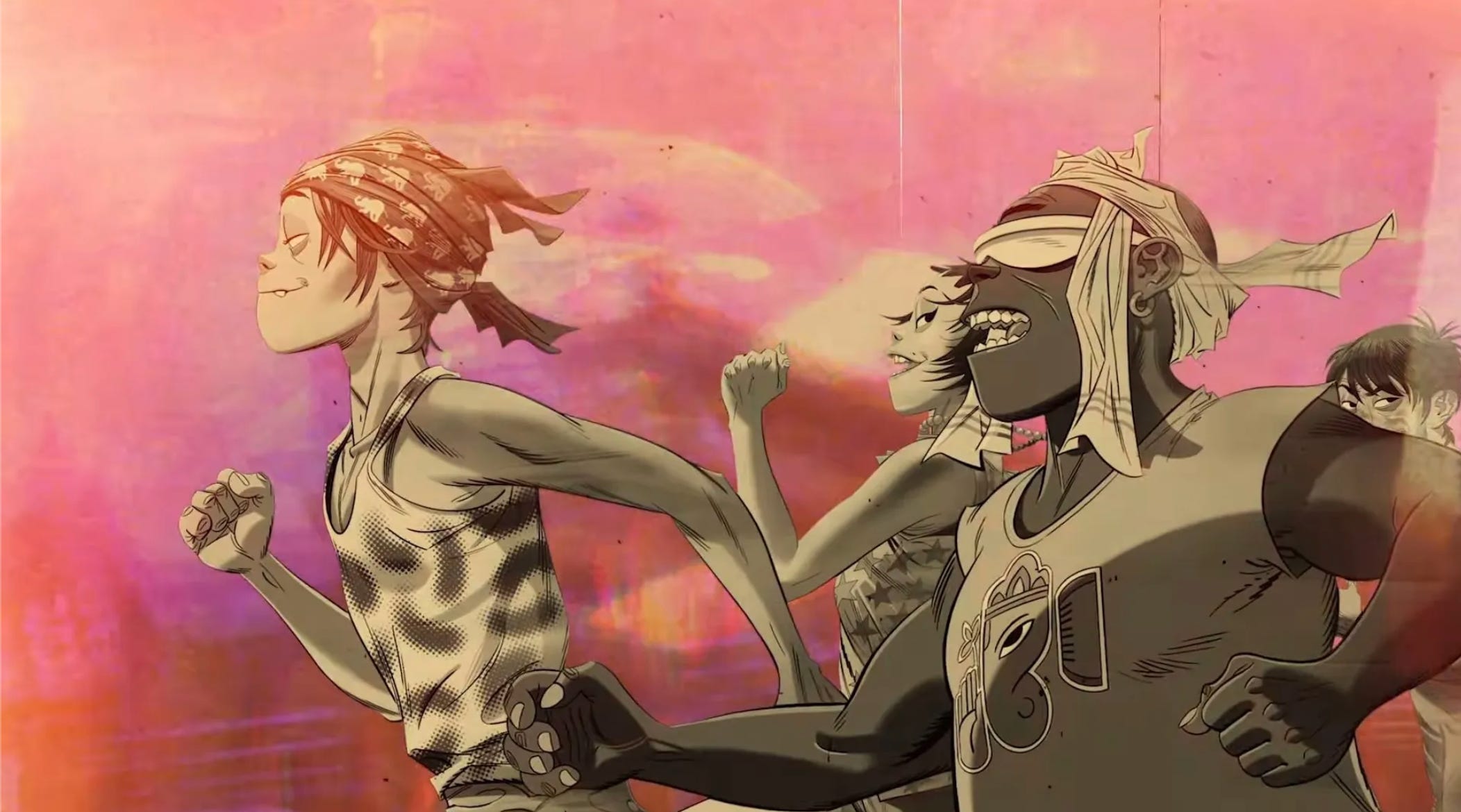
I’m a huge fan of Damon Albarn. I discovered Parklife (1994) when I was 13, driven by an autistic urge to learn as much about music as possible. It revealed how cheeky lyrics can be, how wiry and bold, when you swaddle them in bewildering hooks and melodies.
Which is how Albarn became the anti-Pop Hero of Pop music. The earliest example of this is Blur’s “Song 2”—in which Albarn repeatedly shouts ”Woo hoo!”—a track you’ve definitely heard. Supposedly, it was written as a troll, a satirization of the commercialization of Grunge, a genre premised on anti-consumerism.
Albarn and comic book artist Jamie Hewlett, who co-created Tank Girl, were roommates in the late 1990s when they came up with the idea for Gorillaz, the original virtual band—not in the AI sense, but like Kraftwerk: a human simulation of digital musicians.
It’s been over two decades since Gorillaz became global anti-Pop Pop-stars with their revolutionary sophomore album Demon Days. It was everywhere. The famous clip of the origin of mega-hit “Clint Eastwood” as a garage-sale accident is illuminating in a way I almost resent—it shows us how the magic was performed, that the puppets are operated manually. But this has always been the point of Gorillaz.
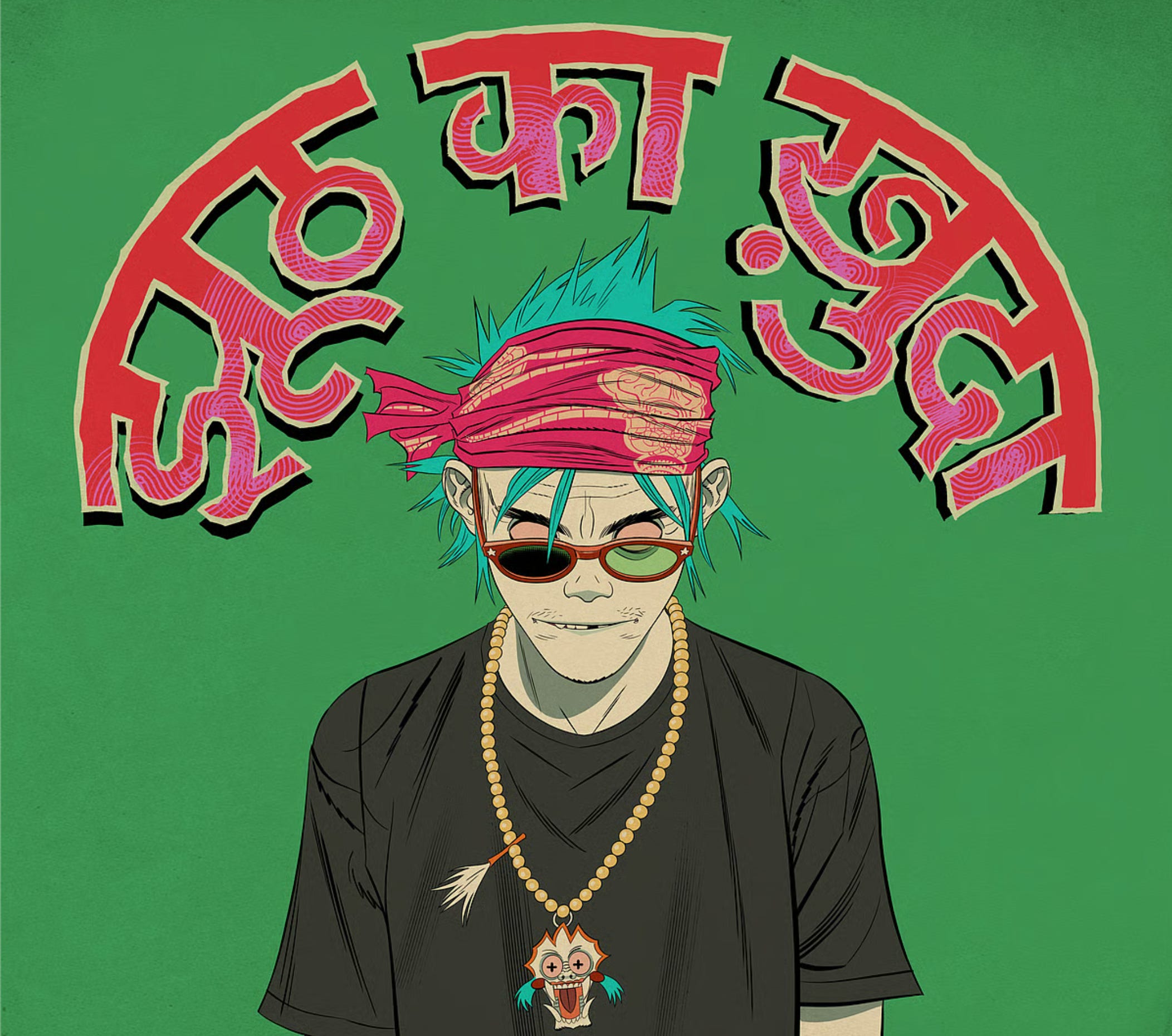
The Mountain, which Anthony Fantano called the “most ambitious [Gorillaz] album so far,” opens with “The Mountain.” Our metaphor is immediate, as the air opens into a stock-footage moment, silk curtains parting to reveal a warm little oasis. The clouds bugle with a sitar cover of “Ob-La-Di, Ob-La-Da,” played by Anoushka Shankar, Ravi Shankar’s daughter.
This brief warm-up leads us to “The Moon Cave,” which is a banger through and through. The slop-turn halfway is beautiful filth — influenced by Hip-Hop (what new music isn’t?), but more advanced, a squall of 808 State chirps and Aphex Twin hyper-melodies, all the machinery of ‘90s electronica glued to acoustic floor toms.
“Shadowy Light” features vocals from Gruff Rhys, with his knack for lovable music. We don’t get the classic Gorillaz sound until “The God of Lying.” Idles is an interesting guest choice. “The Empty Dream Machine” is a Bowie electro-waltz in spangle.
“Damascus” is the only track I instinctively skipped, though I grew to like the heavy-handedness of the Indian influence.
Because The Mountain is worldly, the playbook of a globetrotter. It leaps around Asia like a wealthy tourist would: Japanese Shibuya-kei, Mandarin zither, Bollywood shuffle, Punjab vocal ornamentation, Hindustani tabla. A little bit of Buddhism, some Daoism, some Hindu superstition and Nepalese bansuri. Then it bounces around Africa, then across South America on a motorbike driven by Che Guevara in the form of Trueno, then off to Jamaica on a jet-ski made of conch and Wurlitzer, Dub spliced with reggaeton and Baile Funk, spider-webbed by harp sway.
Even the most proficient musicians of the World genre don’t attempt this sort of continent-hopping. At times, it sounds like some Indian dudes kidnapped Albarn and said, “Make Indian music sound cool or we’ll kill you.” And, to be fair, he succeeded.
At the same time, Albarn is as English as it gets. As the voice and face of Blur, he pioneered a genre literally called BritPop, and The Mountain, with guests like Johnny Marr and Paul Simonon (The Clash), is still British-hearted.
Oddly, the least powerful moments of the album are its Hip-Hop verses, although that’s probably because I have an escalating grudge against a genre I once deeply loved. Viewed more objectively, Albarn lives up to his knack for choosing Common-lineage American rappers who have gotten unfairly trapped on the honor roll of Underground Hip-Hop. And the question of our day, in music, is: What will replace Hip-Hop as the dominant form? Nobody knows. But, despite my grudge, I hope it sounds something like “The Manifesto.”
Like the rest of the album, it forces you to slow down.
You’re not meant to believe in Gorillaz the way you believe in Blur. Not even as a cartoon show, fabulous and convincing as Hewlett’s animation is. The projection and illusion of their performance is itself the veil that deepens its trance. The characters always wink at us, and we’re meant to wink back. Within this gimmick, the band operates on multiple levels simultaneously: Albarn the songwriter, boosted by big-studio production, a rotating cast of collaborators, and a cartoon mythology.
Albarn’s vocal melodies on The Mountain are transcendent. Can you believe he’s still creating gorgeous music full of new emotions and melodies? At this point in their career trajectory, The Rolling Stones, Pink Floyd, The Ramones, Led Zeppelin, and many others, were already cover-band versions of themselves—this is the natural lifespan for most brilliant bands.
Although longevity is rare, there are examples of artists outfoxing it: Sonic Youth, The Beatles, Brian Eno. The finest counterexample related to Damon Albarn is David Bowie, who, while his later career never produced albums like Station to Station (1976), Aladdin Sane (1973), or “Let’s Dance” (1983), delivered bangers right up to Blackstar (2016), his gorgeous final release.
At each stage, Gorillaz have imitated Bowie—perhaps never more blatantly than on The Mountain. “The Empty Dream Machine” might as well be “Seven Years in Tibet.” And “The Happy Dictator” is practically a cover of “Weeping Wall,” right down to the way Sparks, who is himself one of Bowie’s forgotten love children, has Ziggy’s trebly tin-can vocals.
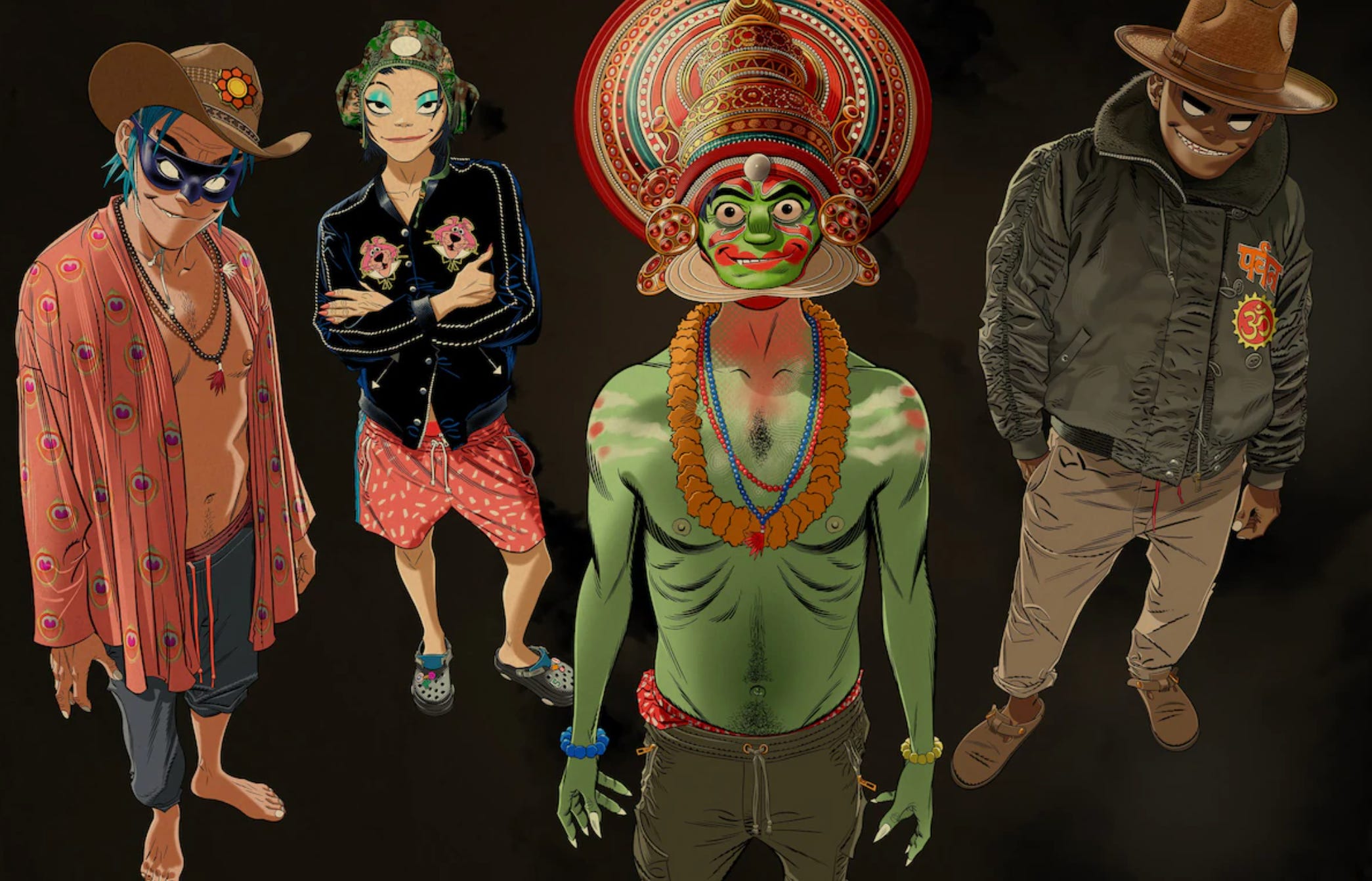
The centuries-old complaint is that Western civilization is dichotomy-minded. Occidental thought has always valued the individual over the collective, each part over the whole—the idea that we are all separate people. We view life as a composition of miniaturizations.
When confronted by the tiny particles of our world, we feel the need to understand them exhaustively, so we magnify them. We disassemble. We reassemble. We take small ideas and turn them into big ideas — monstrosities, often. The reproductions multiply into further reproductions, greater purity, deeper sound, more immersive experience. Our music is often so tangled into the reproduction of endlessly purified sound, high fidelity to excess.
Or at least that’s the conceit. As Korean-German philosopher Byung-Chul Han writes, “Far Eastern thinking, on the other hand, is oriented toward complementary principles. Rather than stiff oppositions, reciprocal dependencies and correspondences preside over being.”
Ask any of my friends or family: If you spend time with me, you’ll be surrounded by music. That’s how I want to be remembered, as having been inseparable from beautiful songs. And when I’m reviewing an album, this soundtracking intensifies. It never stops playing. At all. It’s going even when I sleep and eat and mow the lawn. Partly because it allows me to gauge how quickly my family gets tired of it.
They never reached full burnout with The Mountain, a slick production of maximalist sound—the amusement park of a fire-jeweled sky.
I found the music....interesting. Still not quite ready to step out of my 50 year love affair with Led Zeppelin, but I appreciate how well this review introduced me to a different kind of music. I am fascinated how your brain works!
Oh, and that SNL clip was pretty cool.
I can’t wait to read this!